
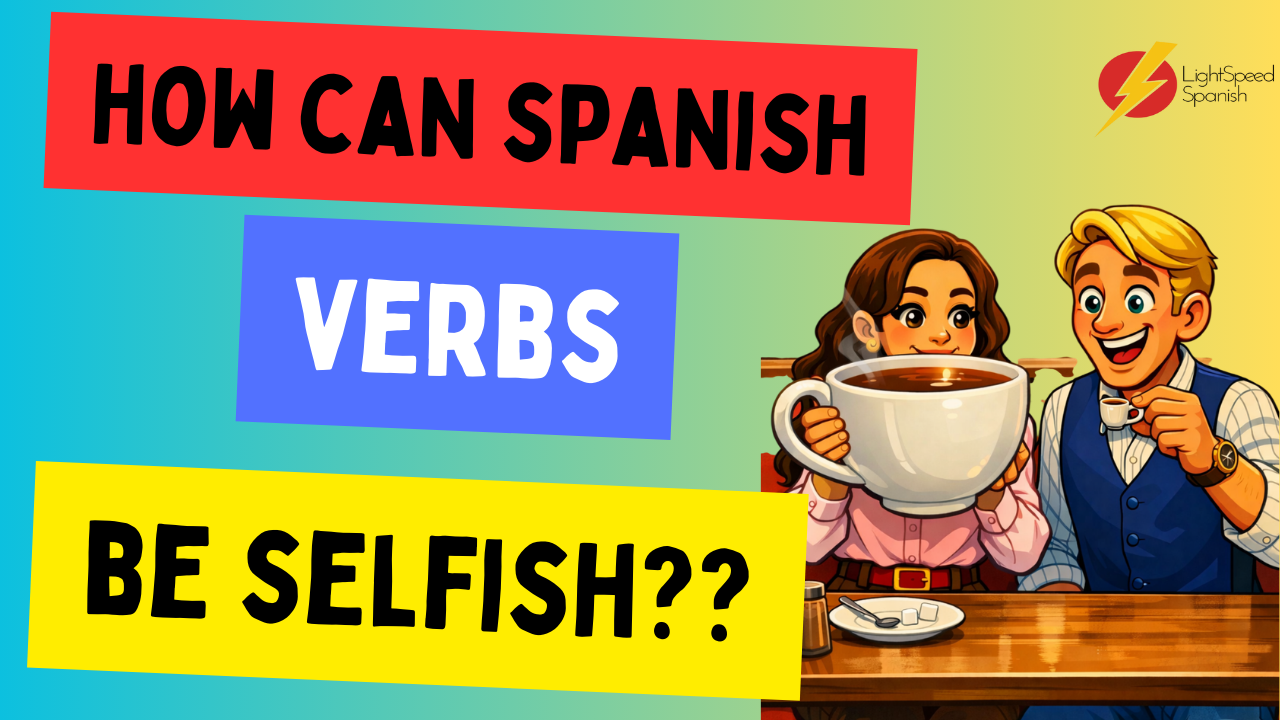
In this fun Spanish lesson, we walk you through the way that we use Spanish Reflexive verbs and what their role is.
Don’t miss Gordon’s little ditty about the fact that AR verbs have an @rse on the end!
Join us and make your Spanish really great and get a handle on Spanish reflexive verbs!
Gordon y Cynthia:)
Get your Intermediate HELPSHEETS here:
Find out more about our Immersion Courses here!
If you would like to join SER SOCIO freely and receive two lessons a week from Gordon and Cynthia of LightSpeed Spanish, just click HERE.
Visit our website here: https://lightspeedspanish.co.uk/
Check out our Hardback, Kindle and Audio Book Range HERE.
Take a look at Cynthia’s Book Club HERE
Join our Telegram group here:
Join us and Support this channel and have the chance to join our live classes HERE:
Find tons of Spanish resources. Browse our Store HERE.
Get your Helpsheets that complement our free Videocasts HERE.
Get your Beginners Verb Conjugating course HERE.
All of our FREE podcasts can be found on Spotify now:
Beginners HERE
Early Intermediate HERE
Advanced Intermediate HERE
Advanced HERE
Be sure to check out our other Spanish student videocasts here.
Un saludo,
Gordon y Cynthia:)
Reaching the intermediate level in Spanish is where the language truly starts to open up. At this stage you are no longer memorising isolated phrases — you are communicating ideas, opinions, humour and personality. You can follow conversations, understand the main point of films and podcasts, and express yourself beyond survival situations. This is the moment learners stop studying Spanish and start using Spanish.
Intermediate Spanish builds the bridge between classroom knowledge and real-world fluency. You learn to manage past and future time naturally, connect thoughts with linking words, and understand native speakers even when they speak at normal speed. Instead of translating in your head, your brain begins to process meaning directly. Confidence increases quickly because you can now participate in conversations rather than just respond.
The cognitive benefits are substantial. Learning another language strengthens memory, improves concentration, and enhances problem-solving ability. Studies consistently show bilingual adults develop stronger mental flexibility and delay cognitive decline later in life. Your brain literally becomes better at handling complexity. You also develop a sharper awareness of your own language — grammar, nuance and tone become clearer because you now see communication from two systems rather than one.
There are professional advantages as well. Spanish is one of the most widely spoken languages in the world, opening opportunities in business, travel, education and international collaboration. Employers value intermediate learners because they can function independently: writing emails, handling clients and navigating real situations without supervision.
But perhaps the most powerful benefit is cultural. Language changes how you perceive people. You stop seeing a translation of reality and start experiencing reality from another perspective. Humour makes sense. Expressions feel natural. Conversations become relationships instead of transactions.
Intermediate Spanish is the turning point where effort transforms into freedom. You gain access not only to a new language, but to a new way of thinking — and that skill stays with you for life.
Your audio
Learn Spanish Resources
Free Videocasts
160+ free podcasts & lessons, each with a comprehensive helpsheet to guide your learning.
Our Fantastic Books
A growing range of acclaimed workbooks explaining Spanish grammar clearly and simply.
Total Immersion Courses
Week-long immersion near Madrid to boost your confidence — Socios get €50 off.
1-to-1 & Group Lessons
Have a free, no-obligation chat with Ana and explore how to take your Spanish further.
Gordon’s Diaries
Hundreds of free diaries where Gordon talks about Spain, life, and everything else.
Cynthia’s Insights
Cynthia shares her view on life in Spain and in general through video diaries.
All of Our Playlists
Browse hundreds of videos on YouTube. Any questions? Write to us anytime.
LightSpeed Spanish App
Download our free iOS & Android app and access lessons on the go.
Any questions? Contact us